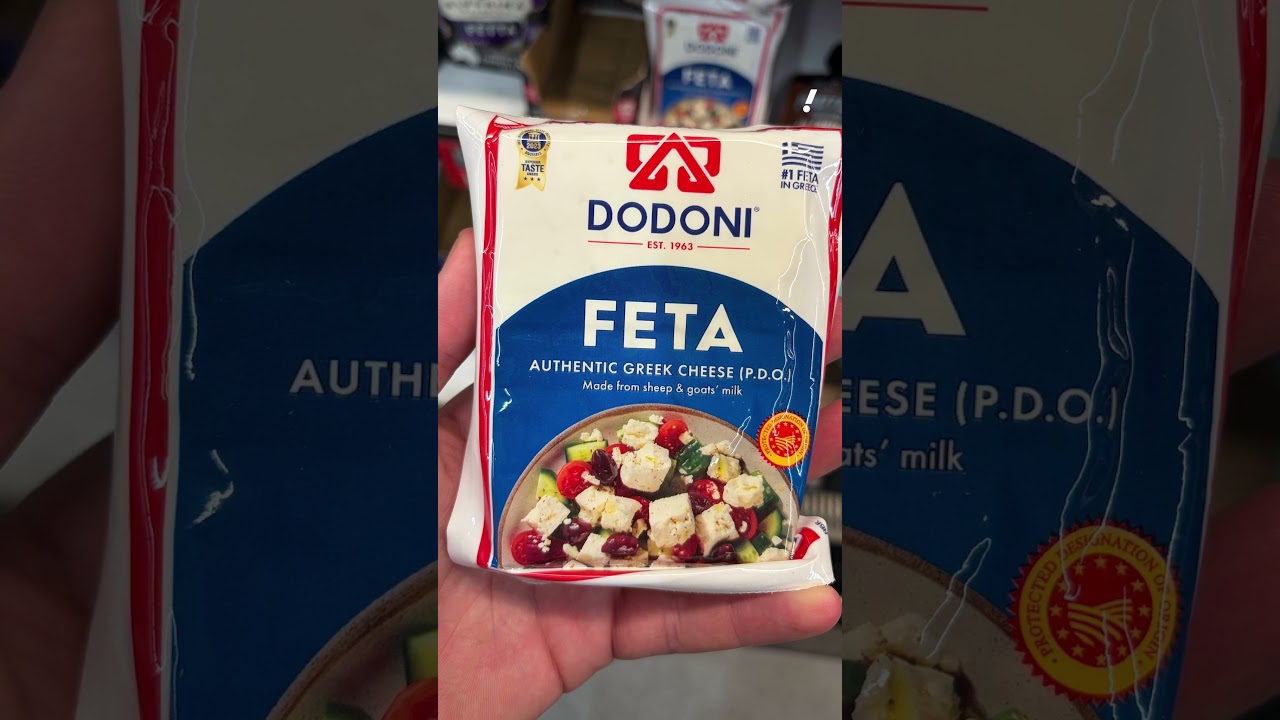
Subscribe and turn on notifications🔔 : https://buff.ly/3F6ZiLt | There’s a little-known difference between two seemingly identical products you’d find at the supermarket.
Many shoppers wouldn’t necessarily notice the label, but the popular cheese is slightly different depending on how the word ‘feta’ is spelt.
Self-proclaimed “food label reading enthusiast” Sylvia told Yahoo Lifestyle she noticed some were labelled as feta and others had fetta. After doing some research, she realised one of the spellings was protected.
“It’s called protected designations of origin (PDO). It’s like champagne, otherwise it’s sparkling wine… I just think it’s something that most people don’t realise.”
PDO is used to protect and identify products produced, processed, and prepared in specific regions, helping consumers know whether something is legitimate or an imitation.
Feta has to be made from sheep’s milk or a mixture of sheep’s milk and no more than 30% goat milk, with the livestock being farmed on Greek soil.
Fetta indicates it’s made elsewhere, such as Australia or Denmark, and created predominantly with cow’s milk.
That’s why you’ll see a lot of fetta products having “Greek-style” on the packaging, as it indicates that it’s not the real deal, but close to it.
Follow us on:
► TikTok: https://www.tiktok.com/@yahooaustralia
► Facebook: https://www.facebook.com/yahoolifestyleau
► Instagram: https://www.instagram.com/yahoolifestyleau
► Website: https://au.yahoo.com/
#YahooAustralia