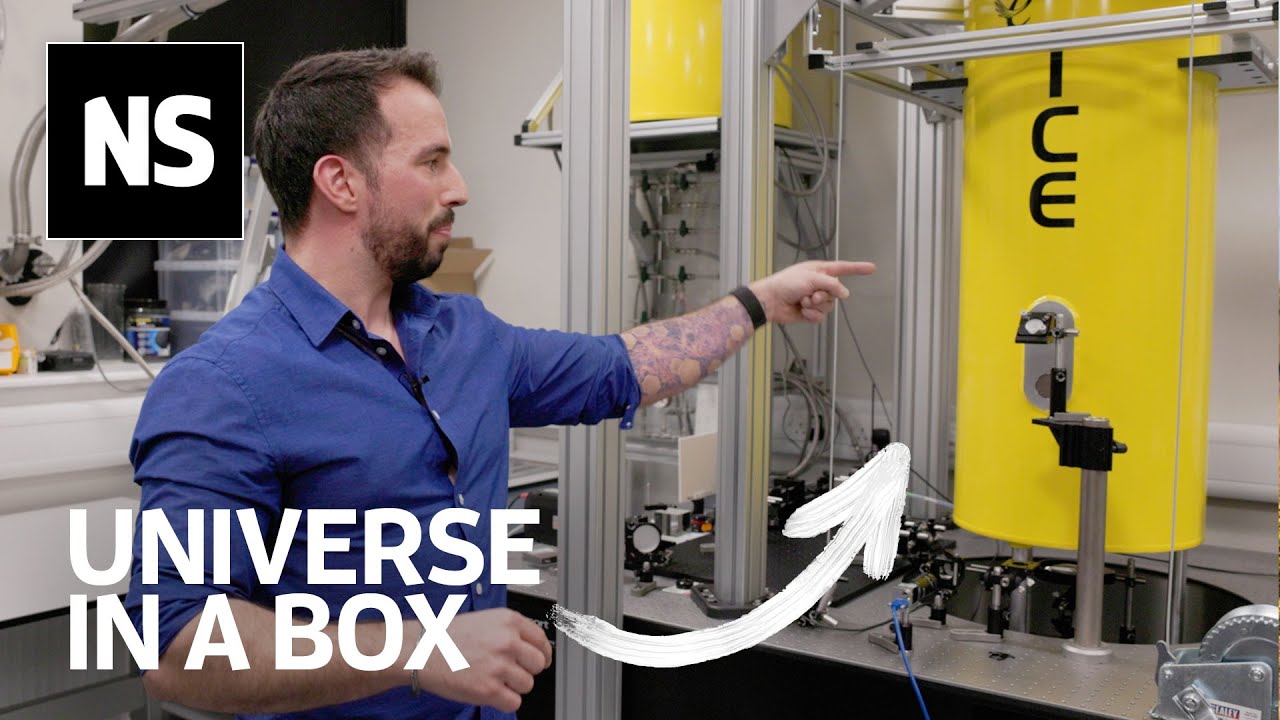
Explore the fascinating world of physics as scientists create a universe in a box and simulate black holes to study phenomena we cannot directly observe.
Inside Silke Weinfurtner’s Gravity Laboratory at the University of Nottingham, her team simulates some of the most extreme phenomena in the cosmos, using superfluid helium, including black holes and, even, the entire universe in a search for quantum gravity.
Mechanical vibrations in one experiment create fluid flows that mimic spacetime around a rotating black hole. And the newer ICE experiment simulates the rapid expansion of the primordial universe. Weinfurtner’s toy universe is underpinned by similar mathematics to these otherwise inaccessible phenomena, allowing inferences to be drawn about how black holes and the early universe behave. In particular, her team can explore how space-time behaves in realms where quantum effects also come into play, which they hope will offer clues towards a long-sought theory of quantum gravity.
–
Learn more ➤ https://www.newscientist.com/video/2480514-liquid-physics-inside-the-lab-making-black-hole-analogues-on-earth/
Subscribe ➤ https://bit.ly/NSYTSUBS
Get more from New Scientist:
Official website: https://bit.ly/NSYTHP
Facebook: https://bit.ly/NSYTFB
Twitter: https://bit.ly/NSYTTW
Instagram: https://bit.ly/NSYTINSTA
LinkedIn: https://bit.ly/NSYTLIN
About New Scientist:
New Scientist was founded in 1956 for “all those interested in scientific discovery and its social consequences”. Today our website, videos, newsletters, app, podcast and print magazine cover the world’s most important, exciting and entertaining science news as well as asking the big-picture questions about life, the universe, and what it means to be human.
New Scientist
https://www.newscientist.com/